
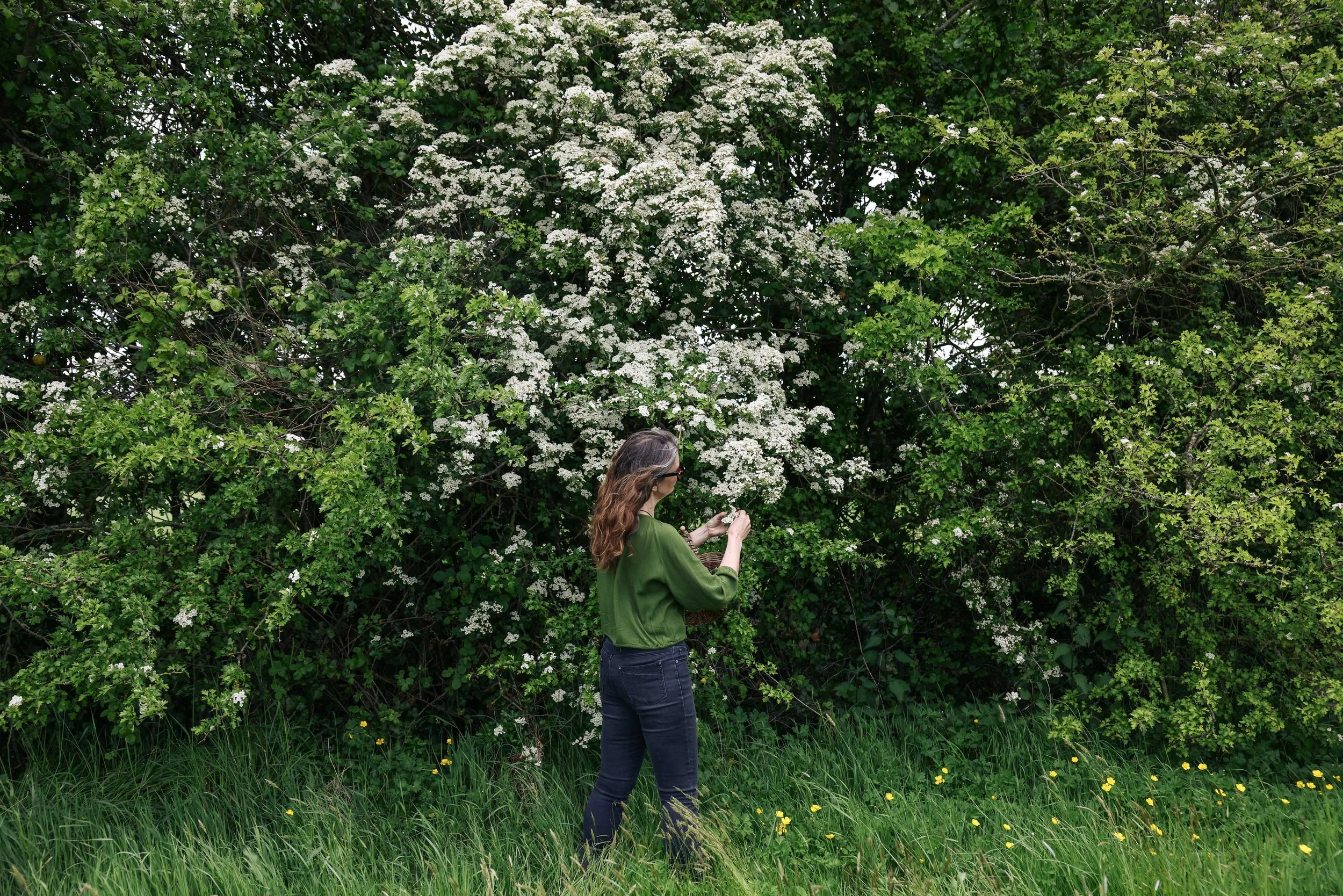
Hawthorn
Crataegus monogyna | Sceach gheal
The hawthorn is the tree that Irish people are most superstitious about. Often referred to as ‘the fairy tree’, it is thought to mark the portal between the realms (our world and the otherworld). Associated with the ‘Good People’ (fairies), people are very cautious and respectful of it. It is one of the most frequently mentioned trees in the Irish National Folklore Collection. There are many stories of harm being done to a local tree only to bring misfortune to the person who injured the tree, and many references to people who refused to harm a hawthorn for fear of retribution from the fairy folk. It is thought to bring bad luck when it is brought inside, but if it is placed at the threshold, it is said to protect the home and its occupants. Never pull the bough of the tree without asking permission from the fairy folk and always collect already fallen flowers and branches instead of picking them. This belief is so ingrained in Ireland, we even diverted the path of a new motorway to save chopping down one particular specimen.
This particular episode was brought to national attention when one of the foremost storytellers of modern Ireland, Eddie Lenihan, objected to the destruction of a particular fairy tree on the grounds that it was where fairies from the province of Connaught meet the fairies of Munster in times of battle. Eddie successfully made the case that to destroy the tree would bring misfortune and the wrath of the Sídhe (the Irish for the fairy folk) upon the construction workers and the motorists who would use the motorway.
Most hawthorn trees are lone trees; it is rare to find a grove of them. You will often find one growing near a stone circle, sacred site or a well. A survey of two hundred wells revealed that over a hundred of them had lone hawthorn trees beside them. They are often used as a clootietree or a rag tree, with small strips of cloth or ribbon tied to the tree as part of a ritual. (It’s important that the material or ribbons used must be natural in order to decompose when exposed to the elements.) The ritual commonly involves something as simple as saying a personal prayer or concentrating on a particular intention while tying a ribbon. Old folklore accounts describe how if a well is mistreated, it can dry up. Some believe that if this happens, its powers are transferred to the rag tree beside it.

Planting / Foraging
Because it is so widespread in Ireland there is no need to try to grow this. We go out with a basket and collect what we need. It doesn’t take long and is more fun when the kids come too.
Uses
So now, if we leave the superstition aside for a moment, imagine a drug that can help to treat congestive heart failure, coronary artery disease and associated conditions such as hypertension and angina completely safely and without any side effects. It would be on every promotional screen outside every chemist in the country and the company making it would have a blockbuster drug on their hands.
Hawthorn is a tonic in the true sense of the word and can be used to treat most car- diovascular disease. Hawthorn’s primary attribute appears to be an ability to improve coronary circulation. It dilates the coronary arteries, relieving cardiac hypoxaemia.
The hawthorn’s medicinal value has been celebrated outside Ireland, in particular in France, Germany and eastern European countries.
The blossom and leaves and the berries can all be used, singly or in combination. Flowers, leaves and berries all work well as a tincture, more so than a vinegar. They can also all be dried and made into an infusion (tea).