
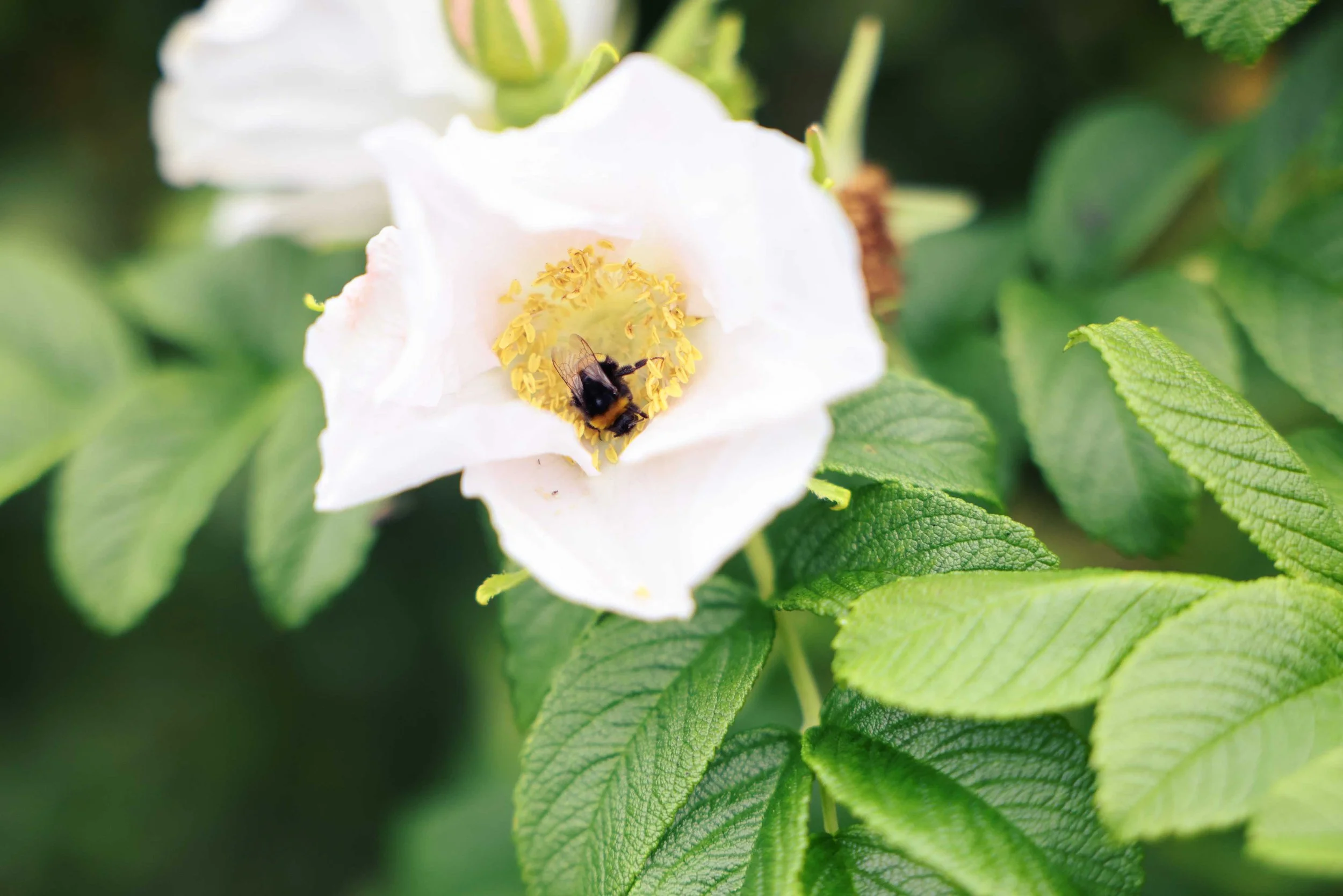
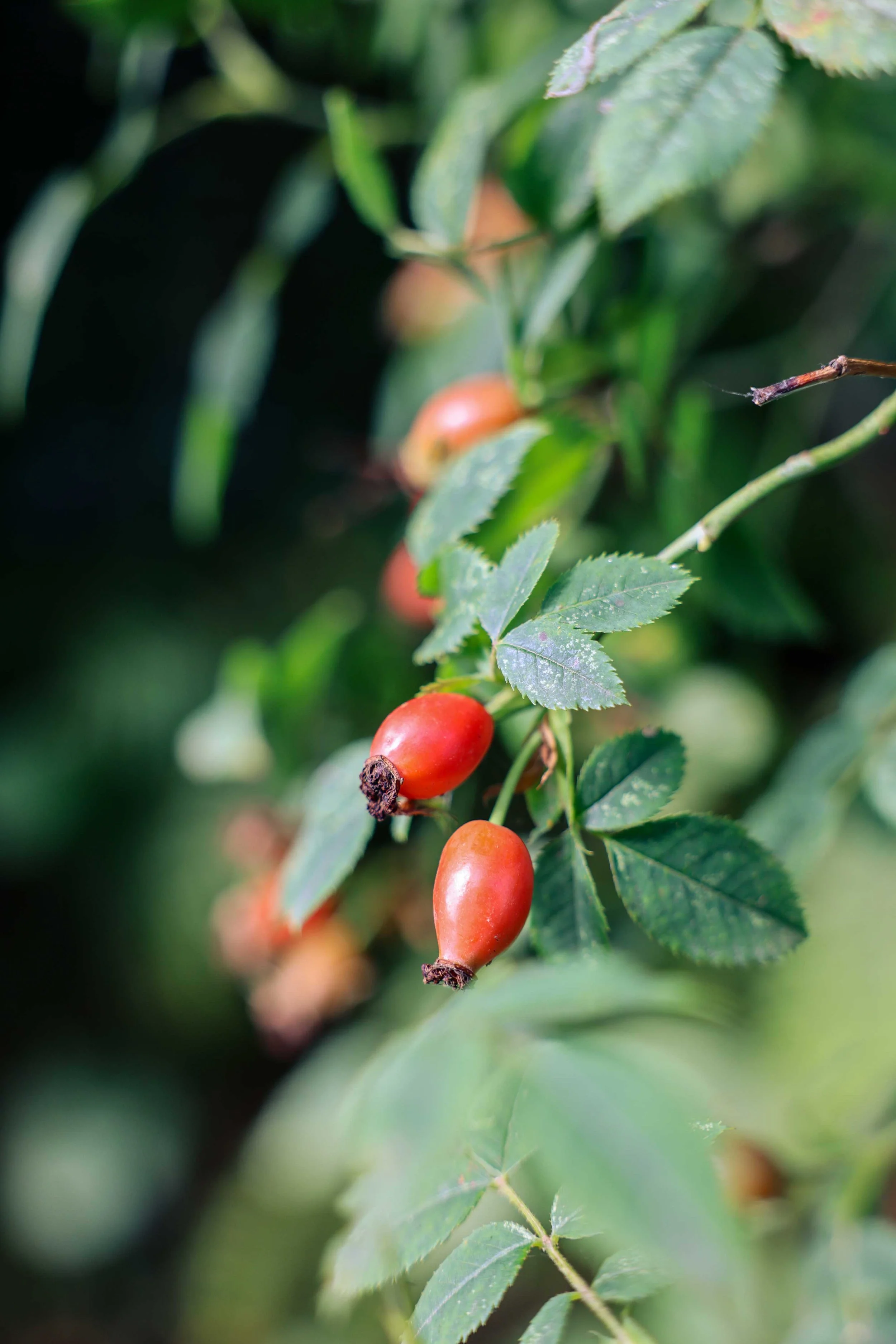
The wild rose of the hedgerows, rosehip or dogrose, has two phases of beauty: the buxom white and light-pink flowers that come out in late June/July and the fruit which then grows from the pollinated flower blossom in September.
Rosehip/Dogrose
Rosa canina | Feirdhris
Planting / Foraging
This is a plant that is easier to forage than to grow. The flower petals can be used in salads, to flavour desserts, to make rose honey, jams and conserves.
The rosehips are bountiful in most hedgerows from September onwards and make a great syrup, jam, vinegar and rum, a bit like the sloes in sloe gin.
Uses
The common name of dogrose comes from the reputed ability of the root of the plant to cure the bites of mad dogs. This theory is attributed to the Romans, and Pliny (the Roman naturalist), in particular.
In his book, Ireland’s Wild Plants (2015), Niall Mac Coitir describes rosehip in the following way: ‘It used to be legally classified as a rough (fíadain) fruit, along with the wild apple, sloe, acorns, haws and rowanberries. Other fruits, like cultivated apples and plums, blackberries and strawberries were defined as sweet (cumra).’ I think that’s a fair enough distinction. I feel that all the rough fruits needed to be cooked in some way to be palatable.
Rosehip is extremely high in vitamin C – it contains twenty times more than oranges. Rosehip syrup and jam are great ways to keep vitamin C levels up over the winter to boost immunity.
In Britain during the Second World War, people were encouraged to make rosehip syrup, particularly due to the difficulty of importing citrus fruit at that time. Interest- ingly, there are very few documented folk medicine uses for rosehips in Ireland, but in modern herbalism rosehip enjoys an elevated status.
Rosehips also have anti-inflammatory properties, which help to relieve the symptoms of colds, flus, sore throats and coughs.
It is also used as a heart remedy and is said to be good for reducing blood pressure, and because of its astringent (drying) qualities, it is great for treating diarrhoea. It can be made into a nutritive tonic, which is cooling and astringent.